

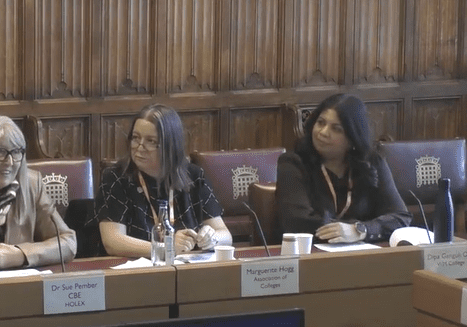
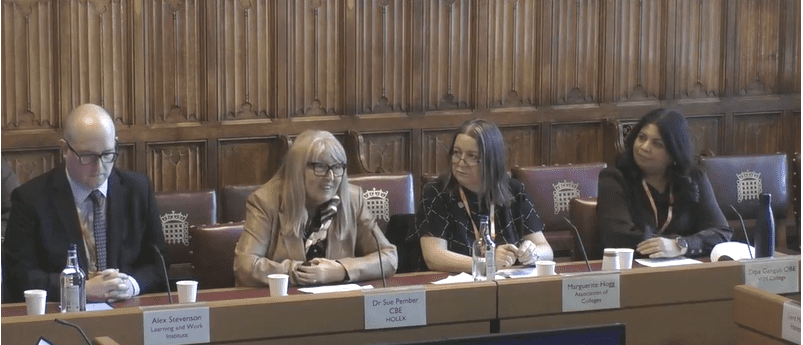
Today, WM College was proud to be represented at the Numeracy for Life Select Committee at the House of Lords, where our Principal and CEO Dipa Ganguli, OBE, was invited to give evidence on the state of adult numeracy in the UK.
This session brought together sector leaders, policymakers and practitioners (Including: Marguerite Hogg, Senior Policy Manager at Association of Colleges, Dr Sue Pember, Policy Advisor at HOLEX and Alex Stevenson, Deputy Director at the Learning and Work Institute) to examine a critical issue: millions of adults lack the numeracy skills needed for everyday life, work and participation in society – and current provision is not keeping pace with need.
Drawing on both national data and lived experience from the classroom, the discussion highlighted not only the scale of the challenge, but also the practical solutions already working on the ground.
The scale of the adult numeracy challenge
The Committee heard that:
- Around 16 million adults in the UK have low numeracy skills
- Approximately 8–9 million have very low skills, below those expected of a primary school child
- Participation in adult maths learning has declined significantly over the past decade
Speakers from across the sector raised concerns about:
- Reduced funding for adult education
- A shortage of specialist maths teachers
- Fragmented provision depending on location
- A lack of policy focus on adult numeracy
There was a clear consensus: without urgent action, it could take decades to close the national skills gap.
WM College’s perspective: what works in adult numeracy
Dipa Ganguli brought a vital frontline perspective, grounded in WM College’s work with hundreds of adult learners each year – many of whom have previously struggled with maths or experienced barriers to education.
Her key message was clear:
Adult numeracy is not just about teaching maths – it is about rebuilding confidence, removing barriers, and making learning meaningful.
1. Confidence comes before competence
For many adult learners, the biggest challenge is not ability, but mindset.
Years of negative experiences in education often lead to deep-rooted maths anxiety. Learners frequently arrive believing:
- “I’m not good at maths”
- “I’ve never been able to do this”
At WM College, the starting point is different. The focus is on:
- Creating safe, supportive learning environments
- Rebuilding confidence step by step
- Helping learners reframe their relationship with maths
Only once confidence grows can skills truly develop.
2. Relevance drives engagement
One of the strongest themes from Dipa’s contribution was the importance of real-life application.
Adults are far more likely to engage when maths is clearly linked to their everyday lives, such as:
- Managing household budgets during a cost-of-living crisis
- Supporting their children with homework
- Understanding payslips, bills, or pensions
- Making informed health decisions
When learning feels relevant, participation increases — and so does progression.
3. “Maths by stealth” is highly effective
A standout insight from WM College’s delivery – particularly through programmes like Multiply – is the success of embedding numeracy into practical activities.
Examples include:
- Cooking sessions to teach ratios, measurements and budgeting
- Sewing and tailoring to explore geometry and proportions
- Shopping scenarios to build confidence with percentages and value comparisons
This approach reduces anxiety and stigma, allowing learners to develop skills without feeling overwhelmed.
4. Functional skills matter more than abstract concepts
Dipa highlighted a critical distinction between:
- Transferable, everyday maths skills, and
- Abstract concepts that are harder to contextualise
Learners respond strongly to:
- Budgeting and money management
- Understanding offers, discounts and value
- Practical problem-solving
By contrast, topics like algebra are often perceived as less relevant and can act as a barrier to engagement.
This raises important questions about how adult maths curricula are designed and assessed.
5. Wraparound support is essential – but costly
Another key insight was the importance of wraparound support in enabling adults to participate and succeed.
This includes:
- Childcare support
- Travel assistance
- Additional learning support in the classroom
At WM College, this support plays a crucial role in retention and achievement. However, it also creates a challenge:
The more support provided to each learner, the fewer learners can be reached overall within existing funding constraints.
This highlights the need for investment that reflects the real cost of effective adult education.
6. Assessment can be a barrier to participation
The Committee also heard that formal assessment requirements can deter many adults from engaging in maths learning.
Dipa emphasised that:
- Many learners are motivated by practical outcomes, not qualifications
- The pressure of exams can reinforce anxiety and disengagement
Programmes like Multiply were successful in part because they:
- Offered flexible, non-accredited learning
- Focused on building confidence and skills first
Dipa also highlighted specific exam questions to demonstrate how inaccessible many assessments are. She showed that maths questions are often multi‑layered and written like English comprehension exercises. As a result, even learners who are mathematically capable can struggle – not because of the maths itself, but because the language demands are unnecessarily complex.
There is a clear opportunity to expand this type of provision to re-engage more adults.
Insights from across the sector
Other contributors reinforced and expanded on these themes:
There are growing concerns about the impact of low numeracy on productivity, employment and economic growth.
Funding constraints were identified as a major limiting factor, with significant reductions over the past decade impacting provision, staffing and learner support.
The end of the Multiply programme has left a gap in flexible, community-based learning opportunities.
Evidence showed that adults do want to learn, but need provision that is accessible, relevant and well-supported.
Strong partnership working – with employers, community organisations and public services – was highlighted as essential to reaching learners who would not otherwise engage.
A System designed around adults
A recurring theme throughout the session was the need to rethink how adult numeracy is delivered.
Dipa summarised this powerfully:
We must teach in the way adults learn – not in the way systems are designed.
This means:
- Creating supportive, inclusive environments
- Starting from the learner’s context and goals
- Making learning practical and relevant
- Removing unnecessary barriers
Looking ahead
The Numeracy for Life Committee session made one thing clear: adult numeracy is not a marginal issue – it is central to the UK’s economic, social and individual wellbeing.
At WM College, we see every day how the right approach can:
- Build confidence
- Unlock opportunity
- Transform lives
But to scale this impact, we need:
- Sustained investment in adult education
- Flexible, learner-centred provision
- Recognition of numeracy as a critical life skill
We are proud to contribute to this national conversation and remain committed to delivering high-quality, inclusive education that meets the real needs of our communities.